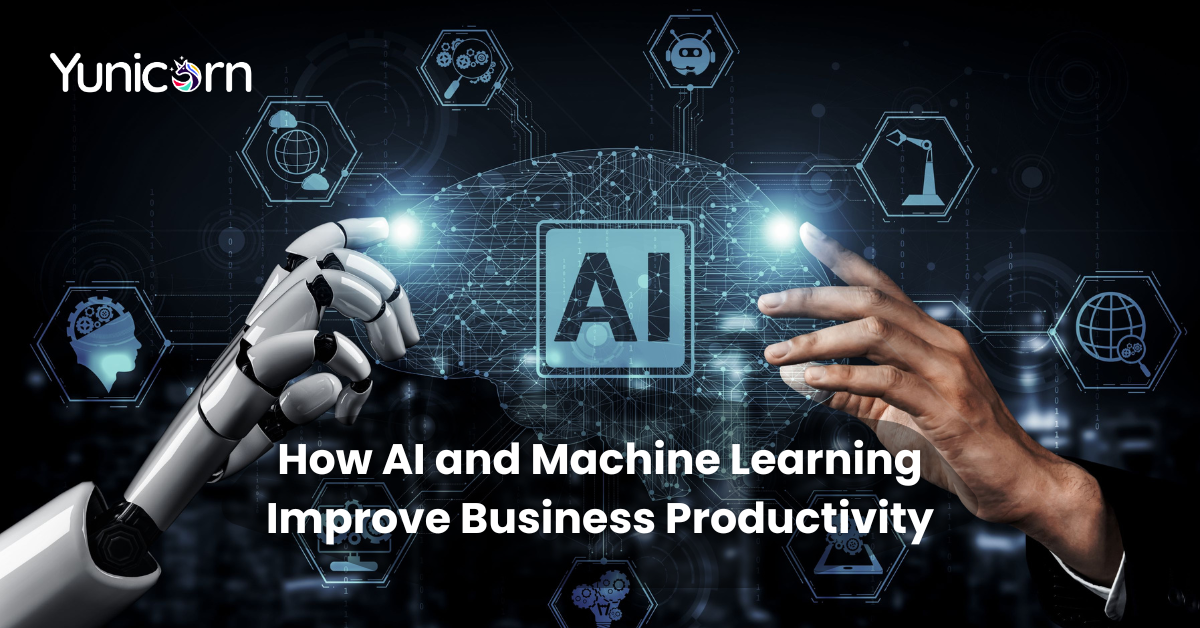
How AI and Machine Learning Improve Business Productivity

In today’s rapidly evolving digital landscape, businesses are expected to achieve greater outcomes while operating with limited resources. Customers expect faster responses, employees want smarter tools, and competition keeps getting tougher across every industry. In this environment, productivity is no longer just about working harder – it’s about working smarter. This is where Artificial Intelligence (AI) and Machine Learning (ML) are playing a transformational role.
AI and Machine Learning are no longer futuristic concepts reserved for tech giants. They have become practical, accessible tools that businesses of all sizes can use to improve efficiency, reduce costs, and unlock new growth opportunities. From automating repetitive tasks to helping leaders make better decisions, AI and ML are redefining how work gets done.
This article explores why AI and Machine Learning matter so much for business productivity and how they are shaping the future of modern organisations.
Before exploring why AI and Machine Learning matter for business growth, it’s worth taking a moment to ensure your technology setup is ready for what’s ahead. If you’re looking for simple and practical ways to get started, you can also check out our recent blog, “5 Simple Artificial Intelligence Ideas for Businesses to Use in 2026” which shares easy-to-apply ideas for using AI in everyday business operations.
Understanding AI and Machine Learning in Simple Terms
Before exploring their impact, it’s essential to first understand what Artificial Intelligence and Machine Learning are.
What Is Artificial Intelligence?
Artificial Intelligence refers to systems or machines that can perform tasks that usually require human intelligence. These capabilities include language comprehension, pattern recognition, decision-making, and the ability to learn from experience.
What Is Machine Learning?
Machine Learning is a subset of AI. It focuses on enabling systems to learn from data and improve their performance over time without being explicitly programmed for every scenario. In simple words, ML allows machines to get better the more they are used.
Together, AI and ML enable software and systems to analyse large amounts of data, identify patterns, predict outcomes, and support smarter actions – all of which directly influence productivity.
Automating Repetitive Tasks and Saving Time
One of the most immediate benefits of AI and Machine Learning is automation. Every business has repetitive, time-consuming tasks that don’t require creative thinking but still demand accuracy and consistency.
AI-powered automation can handle tasks such as:
- Data entry and processing
- Invoice management and billing
- Email sorting and responses
- Appointment scheduling
- Report generation
By automating these routine activities, businesses can free up employees’ time and allow them to focus on more meaningful, strategic, and creative work. This not only improves operational efficiency but also boosts employee satisfaction, as people spend less time on monotonous tasks.
Real-World Example: Automation in Finance and Operations
For example, many mid-sized finance teams now use AI-driven tools to automate invoice processing and expense approvals. Instead of manually entering data and verifying invoices, AI systems can extract information, validate entries, and flag discrepancies automatically. This has helped organisations reduce processing time from days to hours while minimising errors and freeing finance teams to focus on forecasting and strategic planning rather than paperwork.
When machines take care of repetitive work, human talent can be used where it truly adds value.
Improving Decision-Making with Data-Driven Insights
Modern businesses generate enormous amounts of data every day – from customer interactions and sales transactions to website activity and operational metrics. However, data alone doesn’t improve productivity unless it’s understood and used effectively.
AI and Machine Learning help businesses turn raw data into actionable insights. These technologies can:
- Analyse trends and patterns in real time
- Predict future outcomes based on historical data
- Identify inefficiencies in processes
- Highlight opportunities for growth
Instead of relying on guesswork or intuition, leaders can make informed decisions backed by data. Better decisions lead to better planning, fewer errors, and more efficient use of resources – all key factors in boosting business performance.
Enhancing Employee Productivity and Performance
AI is not about replacing people; it’s about empowering them. When used correctly, AI tools act as intelligent assistants that help employees perform their jobs better and faster.
For example:
- AI-powered writing tools can help with drafting emails, reports, and content
- Intelligent search systems help employees find information quickly
- AI-driven analytics tools simplify complex data analysis
- Virtual assistants can manage reminders and tasks
By reducing cognitive load and manual effort, AI allows employees to focus on problem-solving, innovation, and collaboration. This leads to higher quality output and a more productive workforce.
Personalised Customer Experiences at Scale
Customer satisfaction and productivity are closely linked. When customer needs are met quickly and effectively, businesses save time, reduce support costs, and build stronger relationships.
AI and Machine Learning enable businesses to deliver personalised experiences at scale. These technologies can:
- Analyse customer behaviour and preferences
- Recommend products or services based on past interactions
- Personalise marketing messages and offers
- Power chat bots for instant customer support
Example: AI-Powered Customer Support
In customer support, businesses across retail and service industries are using AI-powered chat-bots to handle common queries such as order status, appointment booking, and basic troubleshooting. These systems provide instant responses 24/7, reducing the load on support teams. As a result, human agents can focus on more complex customer issues, improving response quality while keeping operational costs under control.
By automating personification, businesses can handle a larger customer base without increasing workload. This improves both operational efficiency and customer loyalty.
Streamlining Business Operations
Operational efficiency is a major driver of productivity. AI and Machine Learning help organisations optimise internal processes by identifying bottlenecks and suggesting improvements.
In operations, AI can:
- Predict demand and manage inventory more effectively
- Optimise supply chain logistics
- Detect anomalies or errors in workflows
- Improve quality control in manufacturing
These capabilities help businesses reduce waste, minimise delays, and ensure smoother operations. When processes run smoothly, overall organisational performance improves naturally.
Reducing Errors and Improving Accuracy
Human errors are inevitable, especially when dealing with large volumes of data or repetitive tasks. Even small mistakes can lead to delays, rework, or financial losses.
AI systems excel at consistency and accuracy. Once trained, they can perform tasks with minimal errors. Machine Learning models can also continuously improve by learning from past mistakes and new data.
By reducing errors, businesses save time, improve reliability, and increase overall business performance. This is especially valuable in areas like finance, healthcare, logistics, and compliance, where accuracy is critical.
Supporting Faster and Smarter Innovation
Innovation is essential for long-term business success, but it often requires significant time and resources. AI and Machine Learning help speed up innovation by providing insights and automation that would be impossible manually.
For example:
- AI can analyse market trends to identify new opportunities
- ML models can test product variations and predict outcomes
- AI-driven simulations can reduce the time needed for experimentation
By accelerating research, development, and testing, businesses can bring new ideas to market faster without overloading teams. Faster innovation leads to competitive advantage and sustains efficient growth.
Scalability Without Proportional Cost Increase
Traditionally, scaling a business meant hiring more people, increasing infrastructure, and raising operational costs. AI and Machine Learning change this equation.
AI-powered systems can handle increased workloads without requiring the same proportional increase in human effort. Whether it’s handling more customer queries, processing more transactions, or analysing more data, AI enables scalable growth.
Enabling Smarter Workforce Planning
Machine Learning can also play a role in human resource management and workforce planning. By analysing employee data, AI can help:
- Predict staffing needs
- Identify skill gaps
- Optimise team structures
- Improve recruitment and on-boarding processes
Smarter workforce planning ensures that the right people are in the right roles at the right time, which positively influences both performance and employee morale.
Preparing Businesses for the Future
The business landscape is evolving quickly, and adaptability is essential to remain competitive. AI and Machine Learning give organisations the agility to respond to change and stay ahead.
Businesses that adopt AI early are better positioned to adapt to market shifts, meet rising customer expectations, embrace digital transformation, and compete in a technology-driven economy. Investing in AI and ML isn’t just about immediate efficiency—it’s about building long-term resilience.
Overcoming the Fear of AI Adoption
While AI offers clear benefits, some businesses hesitate due to concerns around complexity, cost, or job displacement. Today’s AI solutions, however, are more accessible and user-friendly than ever.
With the right strategy, training, and mindset, AI can be introduced gradually and responsibly. When employees understand how AI supports their work, adoption becomes smoother and more effective.
6. FAQs
1. What is the main benefit of using AI and Machine Learning in business?
AI and ML help businesses save time, reduce manual work, and make smarter decisions, which leads to better overall productivity.
2. Are AI and Machine Learning only suitable for large companies?
No, these technologies are now accessible to businesses of all sizes and can be scaled based on specific needs and budgets.
3. Will AI replace human jobs in the workplace?
AI is designed to support people by handling repetitive tasks, allowing employees to focus on more meaningful and creative work.
4. How does AI improve decision-making?
AI analyses large amounts of data quickly and identifies patterns, helping leaders make informed, data-driven decisions.
5. Is adopting AI and Machine Learning complicated?
Modern AI tools are user-friendly and can be implemented gradually, making adoption easier with the right planning and training.
Conclusion:
AI and Machine Learning are no longer optional – they are strategic drivers of efficiency, smarter decision-making, and callable growth. By automating routine work and augmenting human capabilities, businesses can operate faster, reduce costs, and unlock new opportunities. Organisations that adopt AI thoughtfully today will be better equipped to compete, innovate, and grow sustainably in the future.